Poster · PS01.031a
Benchmarking AI Agents for Reproducible Visualization Generation in Mass Dynamics 3.0 Proteomics Workflows
Can an agent produce the same figure twice, from the same data, and show its working?
Download PDF →Three posters, the 3-Minute Thesis winners, and a collaboration to standardize the proteomics workflow end to end.
Three questions, one underlying problem: results that stay comparable after the experiment is finished and the person who ran it has moved on. If you were in the hall you probably caught one of them. Here are all three.
No form · No email wall · Free to shareCan an agent produce the same figure twice, from the same data, and show its working?
Download PDF →Protein-level and PTM-level evidence in one workflow, with confidence carried through rather than rebuilt at each layer.
Download PDF →Multi-omics connections held in a graph, so they survive the next experiment instead of being redrawn for it.
Download PDF →One slide, three minutes, and a thesis explained in plain language to a room that mostly didn't share the specialty. Explaining your own work to people outside your subfield is a completely different skill from doing the work, and almost nobody gets taught it.
Congratulations to all eleven finalists. Co-chaired by Patricia Sosa-Acosta (KTH Royal Institute of Technology) and Paula Burton (Mass Dynamics). The HUPO ECR program is co-chaired by Livia Rosa-Fernandes and Charlotte Hutchings.
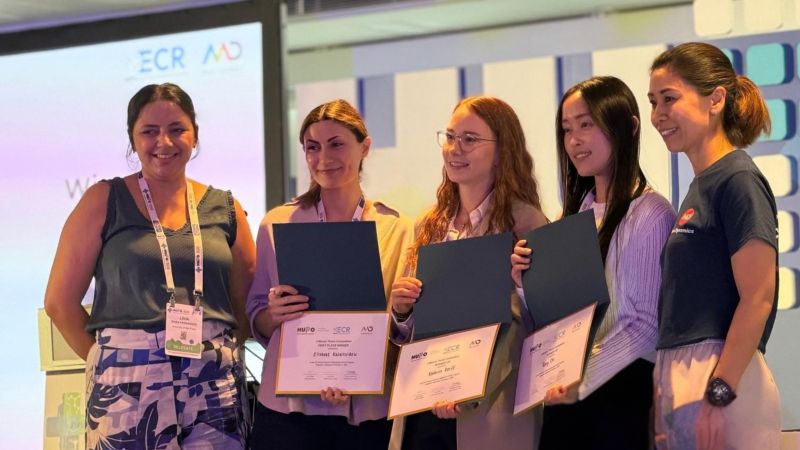
The 3-Minute Thesis final, HUPO 2026, Singapore.
A collaboration with Evosep to standardize the LC-MS proteomics workflow end to end, from sample preparation and measurement through to quality control and interpretation.
MD QC is available with every Evosep Lupo and Evokit purchase. Sample preparation is where a great deal of the variability in proteomics starts, so getting that layer and the analysis layer to agree with each other matters more than it sounds.
Scaling science into sustainable companies. Fourth year it has run, and it works the same way each time: no slides, no pitches, Chatham House Rule, and a room that gets honest about funding because of it. Read more here.
Panel Vera Ignjatović, Yen Choo and Richard Shen. Co-facilitated by Lindsay Pino (Talus Bio) and Paula Burton.
An informal panel on what comes after the PhD, built around the messy middle that career talks usually skip. Andrew Webb talked through the route from research scientist to co-founder, including the parts that didn't go to plan.
Alongside Stacy Malaker (Yale), Lucy Ann Woods (Asterope Life Sciences) and Gustav Ceder. Chaired by Mayara Silva and Daniel Garama.
A 7:45am start on how standardized, high-throughput workflows shorten the path from sample to a result you can act on. Worth the alarm, on the evidence of the room.
Dr Andrew Webb presenting with Prof. Jesper Velgaard Olsen (NNF Center for Protein Research). Chaired by Dr Nicolai Bache, CSO, Evosep.
The posters are what we showed. If you'd rather put your own dataset through it than read about ours, there are two ways in, depending on how you work.